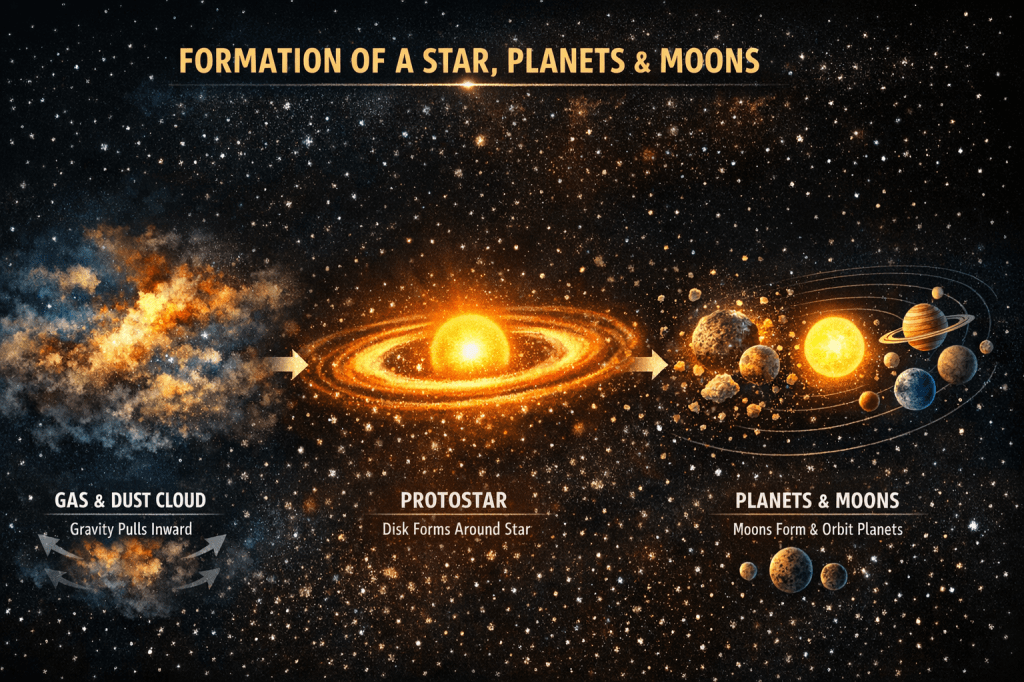
At the most basic level, the universe can be understood as matter (chemicals) + forces (especially gravity), interacting over time.
1.“Chemicals” = matter (what things are made of)
When you say chemicals, in physics we usually mean:
- Elements (hydrogen, helium, carbon, iron…)
- Atoms and molecules
- Gas, dust, rocks, ice, plasma
Most of the universe is made of just:
- Hydrogen (~75%)
- Helium (~24%)
- Everything else (~1%)
These elements are the building blocks of:
- Stars
- Planets
- Moons
- Life
2. Gravity = the main organizer of the universe
Gravity does not create matter, but it organizes it.
Gravity:
- Pulls gas and dust together
- Forms stars from clouds
- Keeps planets orbiting stars
- Holds galaxies together
Without gravity:
- Matter would remain spread out
- No stars, planets, or solar systems would exist
You can think of gravity as the architect of structure.
3. Is gravity the only force? (important clarification)
Gravity is the most important force on cosmic scales, but it is not the only one.
The four fundamental forces
- Gravity
→ Shapes galaxies, stars, planets - Electromagnetic force
→ Holds atoms together, creates chemistry, light, electricity - Strong nuclear force
→ Holds atomic nuclei together - Weak nuclear force
→ Enables radioactive decay, important in stars
So:
- Gravity builds structures
- Electromagnetism builds chemistry
- Nuclear forces power stars and create elements
4. A cleaner mental model
A very useful simplified picture is:
Matter provides the ingredients, forces provide the rules.
Or even simpler:
- Chemistry → what things are made of
- Gravity → where things go
- Energy → what makes things change (so it is not a matter of time?)
5. Why this explains stars, planets, and life
- Gas (chemicals) + gravity → stars
- Leftover matter + gravity → planets
- Chemistry + energy → life
- Stable orbits + time → solar systems
Everything complex arises from simple rules acting for a very long time.
6.One-sentence takeaway
Yes, at a basic level the universe can be understood as matter (chemicals) shaped by gravity and other forces, with energy driving change and complexity.
 RoofGazers